Electricity rates — Florida
A household in Florida using 1,000 kWh a month pays about $1,597 a year on the cheapest of 6 generally available plans — RS Residential Electric from Jacksonville Electric Authority, in effect since October 2025. Schedule retrieved October 8, 2026. A further 2 restricted and 2 older schedules are priced further down but not ranked.
- Average price
- 15.4¢ per kWh
- 12 months to June 2026
- Against the 12 months before
- +6.6%
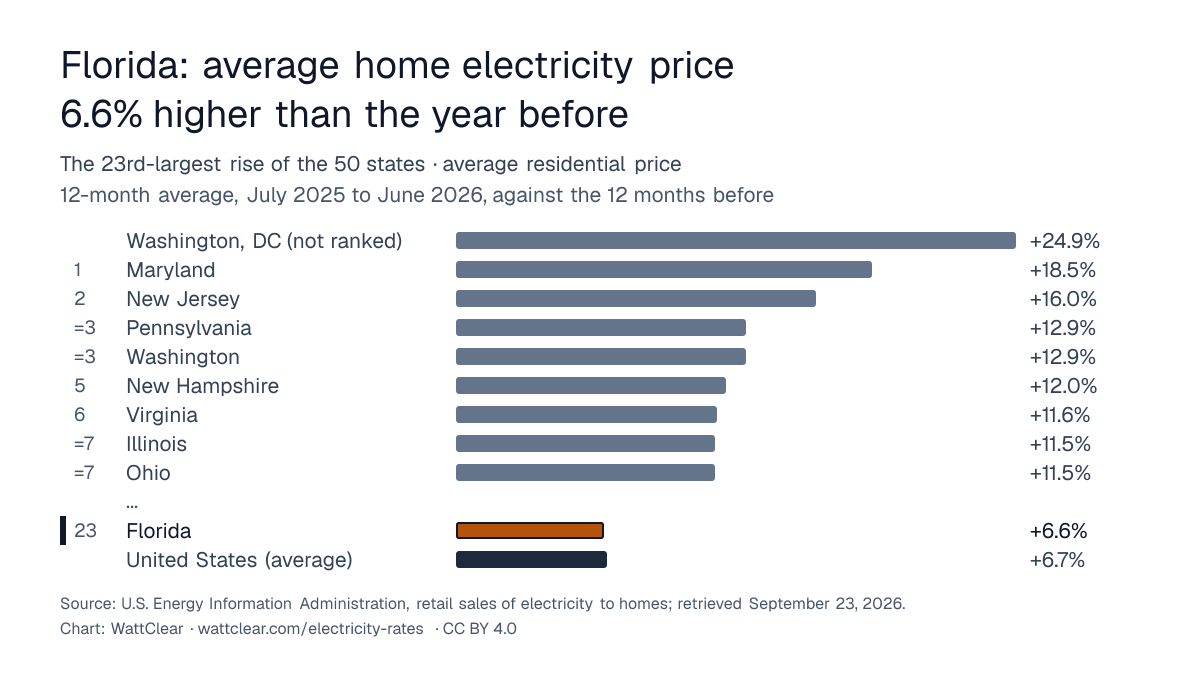
- The 23rd-largest rise of the 50 states
- Average bill
- $168 a month
- 12 months to June 2026, up 4.6% on the 12 months before, though homes used 1.9% less
Every priced plan in Florida, 1,000 kWh/mo
| Plan | Per year | vs cheapest | Effective |
|---|---|---|---|
| RS Residential Electric✓ cheapestJacksonville Electric Authoritytiered · in effect since October 2025 | $1,596.72 | — | 13.3¢ |
| RS-1 Residential ServiceFlorida Power & Light Co.tiered · in effect since January 2026 | $1,597.20 | +$0.48 | 13.3¢ |
| RSL-1Progress Energy Florida Incpriced by season · tiered · in effect since January 2025 | $1,793.58 | +$196.86 | 14.9¢ |
| RS-1 Residential ServiceProgress Energy Florida Incpriced by season · tiered · in effect since February 2026 | $1,823.34 | +$226.62 | 15.2¢ |
| RST-1Progress Energy Florida Inctime-of-use · in effect since January 2025 | $1,849.80 | +$253.08 | 15.4¢ |
| RTR-1 Residential Service TOUFlorida Power & Light Co.time-of-use · tiered · in effect since January 2026 | $2,157.13 | +$560.41 | 18.0¢ |
| Priced but not ranked — restricted, older, or not verifiable as a bill | |||
| RSD Residential Smartsavings ExperimentalJacksonville Electric Authoritytiered · demand charge · in effect since June 2019 · experimental | $673.23 | −$923.49 | 5.6¢ |
| Residential Season Service, RSS-1Progress Energy Florida Inctiered · in effect since January 2018 · older schedule, not ranked | $1,398.84 | −$197.88 | 11.7¢ |
| RSL-2 (Winter Only)Progress Energy Florida Inctiered · in effect since March 2019 · older schedule, not ranked | $1,504.32 | −$92.40 | 12.5¢ |
| GS-1 (General Service Non Demand and Non Metered)Florida Power & Light Co.flat rate · in effect since January 2026 · a general-service class | $1,604.88 | +$8.16 | 13.4¢ |
The cheapest plan in Florida at each level of use
- 500 kWh/mo — cheapest $861.72 (RS-1 Residential Service), dearest $1,141.66, a $279.94 spread
- 1,000 kWh/mo — cheapest $1,596.72 (RS Residential Electric), dearest $2,157.13, a $560.41 spread
- 2,000 kWh/mo — cheapest $3,172.44 (RS Residential Electric), dearest $3,716.91, a $544.47 spread
What a typical bill in Florida costs
At 1,000 kWh a month the 6 generally available plans here run from $1,596.72 on RS Residential Electric to $2,157.13 on RTR-1 Residential Service TOU, with a median of $1,808.46.
Effective rates span 13.3¢ to 18.0¢ per kWh at that usage.
What households in Florida pay, by EIA's count
Florida's residential electricity averaged 15.4¢ per kWh over the 12 months to June 2026, the 23rd-lowest of the 50 states and DC and 14% below the US average of 17.9¢. It sits between Arizona (15.4¢) and West Virginia (15.5¢).
EIA lists 37 utilities serving homes in Florida. By homes served, the largest 5 are Florida Power & Light Co (5,236,277), Duke Energy Florida, LLC (1,793,067), Tampa Electric Co (757,280), JEA (470,564), and Orlando Utilities Comm (248,683). Municipal utilities supply about 13% and member-owned cooperatives supply about 12% of its households.
Florida homes used the most electricity in August and the least in November (2021–2025): a summer peak, 1.6 times the lightest month. August's bills were the highest, averaging $203; March's the lowest, $126. Per kWh, May and September were within 4.6% of each other.
The utilities with a ranked plan on this page serve about 72% of Florida's households: Florida Power & Light Co. (5,236,277), Progress Energy Florida Inc (1,793,067), Jacksonville Electric Authority (470,564). Their median plan at 1,000 kWh a month works out to 15.1¢ per kWh, 2% below EIA's average, which is why this page compares that median with other states'.
| Average price, 12 months to June 2026 | 15.4¢ |
|---|---|
| Among the 50 states and DC | 23 of 51, 1 = lowest |
| US average, same months | 17.9¢ |
| Change on the 12 months before | ↑ +6.6% |
| Change over five years | ↑ +33.1% (US ↑ +34.7%) |
| Average price in 2001 | 8.6¢ |
| Households, 2024 | 10,411,496 |
| Average use per home, 2024 | 1,108 kWh a month (US 872) |
| Average bill per home, 2024 | $156.57 a month (US $143.64) |
Chart of this for reuse (PNG), free to republish under CC BY 4.0 with credit to WattClear. Suggested alt text: “Bar chart. Florida's average home electricity price, July 2025 to June 2026, was 6.6% higher than the 12 months before, the 23rd-largest rise of the 50 states. Washington, DC: +24.9%. United States average: +6.7%. Source: U.S. Energy Information Administration.”
Every year’s figure for Florida
| Year | Florida | US |
|---|---|---|
| 2025 | 15.2¢ | 17.3¢ |
| 2024 | 14.1¢ | 16.5¢ |
| 2023 | 15.2¢ | 16.0¢ |
| 2022 | 13.9¢ | 15.0¢ |
| 2021 | 11.9¢ | 13.7¢ |
| 2020 | 11.3¢ | 13.2¢ |
| 2019 | 11.7¢ | 13.0¢ |
| 2018 | 11.5¢ | 12.9¢ |
| 2017 | 11.6¢ | 12.9¢ |
| 2016 | 11.0¢ | 12.5¢ |
| 2015 | 11.6¢ | 12.7¢ |
| 2014 | 11.9¢ | 12.5¢ |
| 2013 | 11.3¢ | 12.1¢ |
| 2012 | 11.4¢ | 11.9¢ |
| 2011 | 11.5¢ | 11.7¢ |
| 2010 | 11.4¢ | 11.5¢ |
| 2009 | 12.4¢ | 11.5¢ |
| 2008 | 11.7¢ | 11.3¢ |
| 2007 | 11.2¢ | 10.7¢ |
| 2006 | 11.3¢ | 10.4¢ |
| 2005 | 9.6¢ | 9.4¢ |
| 2004 | 9.0¢ | 8.9¢ |
| 2003 | 8.6¢ | 8.7¢ |
| 2002 | 8.2¢ | 8.4¢ |
| 2001 | 8.6¢ | 8.6¢ |
Highest in August, $203; lowest in March, $126.
Every month’s bill in Florida
| Month | Average bill |
|---|---|
| January | $139 |
| February | $130 |
| March | $126 |
| April | $133 |
| May | $155 |
| June | $180 |
| July | $199 |
| August | $203 |
| September | $187 |
| October | $156 |
| November | $129 |
| December | $129 |
In the guides: Summer and winter bills, state by state
How Florida compares
At 1,000 kWh a month the median plan in Florida costs $1,808.46 a year: the 7th-lowest of the 30 states whose indexed plans stand for them, and 21% less than their median of $2,303.60. It sits between Arizona ($1,794.34) and Alabama ($1,881.80).
Its cheapest open plan, RS Residential Electric from Jacksonville Electric Authority at $1,596.72, is the 7th-lowest of the 30 states' cheapest plans.
2 of its 10 priceable plans price by the hour, the 8th-smallest share of any state here.
The largest fixed charge on any plan here is $19.25 a month, the 8th-smallest such charge of the 30 states.
In the guides: What published electricity plans cost, state by state · What a plan charges by the hour, and what moving a kilowatt-hour is worth · What a bill costs before a single kilowatt-hour
What each provider in Florida costs
3 utilities serve customers across Florida in this data. At 1,000 kWh a month the cheapest of them is Jacksonville Electric Authority at $1,596.72 a year on RS Residential Electric; the dearest is Progress Energy Florida Inc at $1,793.58.
That is $196.86 a year between the best each provider offers.
Cheapest available plan by provider: Jacksonville Electric Authority $1,596.72; Florida Power & Light Co. $1,597.20; Progress Energy Florida Inc $1,793.58.
Which plan in Florida is cheapest as use rises
The cheapest plan in Florida changes with consumption. At 500 kWh a month RS-1 Residential Service wins at $861.72 a year; at 2,000 kWh RS Residential Electric wins at $3,172.44.
The penalty for a poor choice grows with usage: $279.94 a year at 500 kWh against $544.47 at 2,000 kWh.
How Florida's plans are structured
Of 10 priceable plans: 8 tiered, 2 time-of-use, 2 priced by season, 1 with demand charges, 1 flat-rate.
Fixed monthly charges run from $4.61 to $19.25.
Who provides Florida's plans
These plans come from 3 utilities: Florida Power & Light Co., Jacksonville Electric Authority, Progress Energy Florida Inc.
The largest saving among Florida's plans
Moving from RTR-1 Residential Service TOU to RS Residential Electric saves $560.41 a year at 1,000 kWh a month, with no change in consumption.
What the Florida figures do not cover
2 of these plans price by the hour; their figures assume the typical hourly pattern of homes in Florida, not this household's own hours.